Showing posts with label berm. Show all posts

Sunday, February 26, 2017

Permaculture Usually Makes a Mess

Permaculture is an ongoing experiment.

We get an idea on how to make things work better, more simply, more in tune with natural flows, with less force from us. We set it in motion, and then watch to see how things turn out. It's a lot like the spiritual path in that way. Learn about something; gain an insight; try it out; see what happens.

And our experiments aren't always beautiful.

Our small farm is on a gentle slope overlooking Laurelwood Valley. It gets sun and rain, soft breezes and storms, visits from wild critters, and the wanderings of our domesticated friends. It's an ideal laboratory.

Autumn leaves are part of permaculture
We've built berms of all sizes and designs. Some are pond muck, clomped and ragged with crags and crannies; miniature Himalayan ranges. Some have chunks of tree trunks, carted in from the Ananda Portland Community, covered with pond muck or garden debris. Others are brush piles, some covered with rich garden soil, some uncovered, providing safe harbor to tiny birds, snakes, and scurrying creatures, the entwined branches slowly collapsing into a composted future.

And all of them are a mess.


Animals are part of permaculture
Our llamas are roamers. They migrate up and down our hillside several times a day. During the rainy winter, they churn up the sodden pasture, sinking up to their ankles with each regal step. We spread straw over the choppy thoroughfare, and wait while the llamas rototill the straw into the mud. We walk across the sloppy mess with our wide, muck boots, leveling the divots, restoring evenness here, then there. The straw breaks down, the worms get to work, we spread some seed, and our pasture thrives.

It's a messy process.


Composted kitchen scraps, fallen leaves, chicken straw, and landscape clippings cover the garden soil, their nutrients seeping down to bring worms by the score, each one a tiny rototiller, leaving castings in their wake. I see eggshells and browned leaves, clumped and slimy from the rain. Despite the mess, I imagine what's happening in the soil beneath, and my heart sings.

The critters' wake is not always beautiful
Our ducks dabble through divots brimming with rain, along the edges of our chortling, seasonal streams, across their spring-fed pond, bringing up mud and murk, staining the pristine flow wherever they wander. Our chickens scratch and forage, scattering compost onto walkways, straw onto gravel, unearthing defenseless ground covers.

They all make a mess.


And yet our hillside is coming alive. After decades of overgrazing and intensive harvesting, we moved onto our crippled hillside to love and nourish it. We tromp around in our wide boots, talking to critters and admiring hearty growth. We delight in the ducks dabbling, the chickens scratching, and the llamas' regal migrations.

Tiny birds that I cannot name dart and flit, colorful and busy with their day. Orchard trees awaken and spread their limbs. Pasture grasses flourish and spread. Chickens murmur and examine. Llamas wander and graze, stand firm to gaze out across our valley, heads high, watchful. Ducks waddle and call, dabble and float, a graceful armada.

I see past the mess, and all I feel is beauty and peace.

Wednesday, December 30, 2015

Why Berms?


Our small farm sits on a gentle hillside overlooking the Laurelwood valley. Having recently moved here from the Bay Area, we’ve had lots of visitors curious to see our new life. They’ve trickled up the coast, landed on our doorstep, and amid glad greetings, we’ve shown them around our farm, discussing plans and options for our simple hillside.
Several people recommended building berms.
I just didn’t get it. When it rains here in Oregon, it rains off and on for months. Keeping moisture on our hillside is not a problem. Helping it get off our hillside without taking the topsoil with it was working pretty well, so why did we need berms?
We’ve had two long, hot summers in a row. Everyone assures us that it’s quite unusual for it to be so hot for so long. It didn’t rain at all, for months. It felt like California, only prettier. I looked out over our dried hillside, watched our llamas wander here and there, grazing the grass down to sub-inch frailty, and still didn’t quite understand how berms would help.
Then we visited the Ananda farm on Camano Island. They had been building swales and berms for two years and were suffering through the same drought that strangled our hillside. We stood and looked out over their lush vegetables, prodded the deep mulch beneath our feet, and finally understood berms.
So we committed to adding berms to our hillside. They would help retain moisture through the dry season. They would soften the impact of the long rainy season. They would add nutrients to their downhill shadow. They would increase the surface area of the pasture, providing more forage for the llamas.
We committed and the universe responded. Friends from the Ananda Portland Community called and asked if we had any use for a large stack of old tree-stump sections. Yes! We suddenly had the base for two entire berms. Could we use the mulch created while grinding out some large stumps from Living Wisdom School? Yes! A beautifully mulched, previously bare stretch of pasture.

Our neighbors asked if we wanted the old lumber from a rotted tree house, old enough to not be pressure treated. Yes! More berm material. Could we use a gigantic pile of brush left over from a fall clean up day at the Community? Yes! Three more berms.
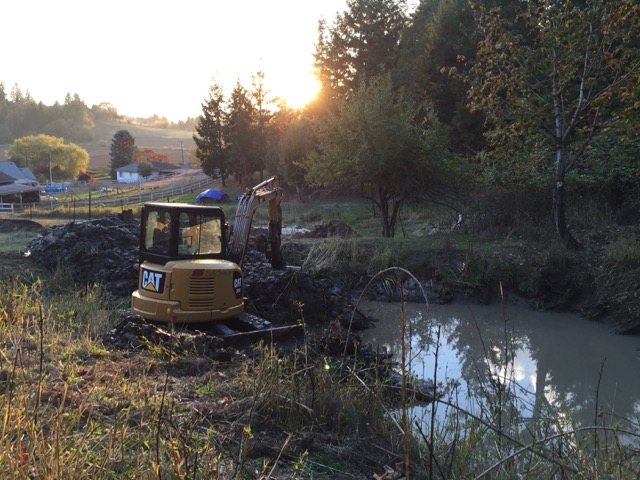
Another neighbor dug out our marshy pond and the marsh muck formed several more berms. Digging out the overflow trench for the pond gave us another two.
One neighbor cleared out an overgrown path across the front of his property. He obligingly dragged his brush into our lower pasture, giving us the material for three more massive berms.
Gardeners cleaned out another neighbor’s yard and dumped all of the cuttings onto yet another berm. Another load of firewood laid the base for two more.
And we have barely begun our fall and winter pruning and trimming.
Our hillside is covered with berms. The chickens stroll through the maze, murmuring to each other, scratching the softening surface, aerating the soil. The llamas add their rich manure pellets that we sprinkle along the berms. The rains have started, the organic matter is starting to break down, the nutrients are trickling down into our soil. Our hillside is drinking deep.
We made a simple commitment, and solutions came from every direction, each one completely unexpected and unplanned. It’s only been two months, and our hillside is wonderfully transformed. It will take some time for the berms to melt down to the point that they can support plants themselves, and in the meantime, they slowly, generously, continuously feed our hillside.
The simplicity of the concept of berms, the simple act of committing to build them, and the simple solutions that presented themselves, one after the other, after the other, leaves me with a deep sense of peace and joy. The llamas, the chickens, the rain, the sunshine, and the berms will work together, creating a healthy hillside that will flourish for decades. We will watch the transformation, breathing in the deep beauty of this simple life we live.