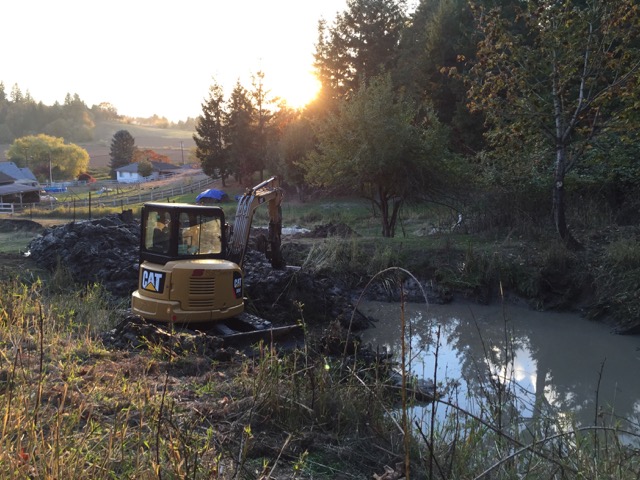
Dambara and I have lived on this gentle hillside overlooking the Laurelwood Valley for four years, almost to the day. I moved up from the Bay Area in mid-August, and Dambara followed at the end of September. During our four years, we've fixed things, grown things, raised things, improved things. I've loved it. Dambara might not have loved it quite as much, but he has been consistently good natured and supportive.
I came here to heal. Adrenal fatigue has ruled my dysfunctional days since 2010; ups and downs, of course, but dysfunctional almost always. Many sources, including professional healers and online advice, stressed the absolute necessity of eating fish and fowl as the only possible path to recovery from adrenal fatigue, so I abandoned my 12 years of vegetarian meals and gave it a try.
Last January, I read the story of a medical medium who suggested that a vegan diet could vanquish the underlying cause of adrenal fatigue. Since I had given the fish-and-fowl strategy seven years to make a difference to no avail, I decided to try something different. And a vegan diet has made all the difference.
My brain can think again. My body can withstand physical labor. My intuition can provide creative solutions once more. I am finally, finally, healing.
Simultaneous with improved health, a series of events have convinced me that our time on this hillside is complete. A cold spring sabotaged our vegetable garden. Several trees died. An orchard expert pronounced me foolhardy. And a daytime raccoon forced us to find safe homes for our ducks and chickens, homes not on our farm. And what's a farm without ducks and chickens? A lonely, empty place.
So, during an eight-minute conversation, Dambara and I decided to sell the farm, and we haven't looked back since. The decision felt right, and after four weeks of hard work to finish all of our projects-in-process, it still feels right. The farm went on the market two days ago, and we'll see what happens.
If all goes well, we plan to buy one of the lots from the Ananda Center at Laurelwood, which is directly across the highway from our farm, and then we'll build a house. We plan on building a group house, with shared common rooms and private bedroom suites. We have friends who are enthusiastic about the project, so we'll be planning, building, and living together. All of it promises to be simply lovely and loads of fun.
Our chapter of the Llamas and Niyamas Farm is closing, and an entire world of possibilities is opening wide.
Showing posts with label simple living. Show all posts
Sunday, July 30, 2017
Sunday, April 23, 2017
Farming with a Trowel
I was about six years old when I started tending my first garden. Even then, I loved pulling away the chaotic weeds to make room for orderly groups of flowers and herbs, relishing that satisfying accomplishment of checking in later and seeing them flourishing.
Over the years, the gardens I've tended have gotten larger and more complex, to eventually include ponds, fruit trees, wide assortments of bulbs, roses, trellised vines, lush ground covers and, of course, vegetables. Does everyone enjoy the taste of home-grown tomatoes or strawberries warm from the sun?
Despite the increased sizes and complexities, I've consistently had the problem of running out of dirt. It's too hard to choose between a rose bush with vibrant yellow blossoms blending into deep orange edges and one with rich, purplish pink blossoms. Just get both. Find room somehow.
And then we moved to Oregon.
I remember our first spring, exploring the friendly, neighborhood nursery, with greenhouse after greenhouse burgeoning with plants of every size, shape, scent, and color. Oh, Lordy. Thank goodness for the cargo van waiting for me out in the parking lot.
One variety that I brought home that was new to me was artichokes. I bought three, 4" pots and carried them up to the empty patch of soil that I thought would make the perfect home for them. THAT'S when I read the label advice. "Plant 5 feet apart." What!!!! That's ridiculous. How could they possibly fit? And then I looked around at the empty patch of soil and realized, no problem.
I'd also picked up some bare root strawberries, which I'd never heard of before. They were on sale for $2/bundle, so of course I bought 3 bundles. As I untied the first bundle, I again read the label advice. "Plant 1 foot apart." It also said, "25 plants." What!!!! I had 75 plants that needed to be planted 1 foot apart? I looked around at the still-waiting patch of soil stretched out next to the new artichokes. Actually, no problem.
Our farm is 2-1/2 acres. Of course, a healthy chunk of it is taken up by buildings and driveways, and most of it is in pasture, but there is so! much! room!
So we're migrating over from gardening into something larger: Farming. The thing is, I've spent 50-some years gardening with a trowel. And hand clippers, loppers, and rakes. I love the heft and power of a grub hoe, but that's as big and powerful as it ever got.
But you know what? It still works.
Our first summer, we tackled the overgrown blackberry briars, intertwined with hundreds of thistles and tall grasses that engulfed the upper third of our hillside. Our tools? A lopper and an electric hedge trimmer. Foot by foot, our little tools chipped away at the chaotic, waist-high thicket, and the contour of the hillside slowly emerged.
That was how we discovered that we had a pond. Who knew? But there it was, a full-fledged pond at the top of our property.
It was an entire summer of discovery. The pond has a dam. The formerly inaccessible pluot tree is actually peacefully poised on it's own little plateau. Another plateau overlooks the pond and is a perfect place to linger, with an expansive view of our beautiful valley. We uncovered lemon verbena and an entire, miniature stream, gurgling along the lower edge of our pasture.
Our tools? Every one of them was easily held in our hands.
Now, if we were trained as farmers, we probably would have borrowed a tractor from the Ananda Center at Laurelwood and powered our way across the gentle contours of our hillside, wiping out everything in our path, tossing about new pasture seed, and getting the job done!
We have borrowed the tractor from time to time, for jobs that are mightier than our four hands. But for the most part, we wield scythe, lopper, rake, and yes, trowel to tame the chaos and nurture the beauty inherent in every inch of our hillside. By working with our hands, by using our own muscles and breath, surrounded by shining sun or drizzling grey, we feel a connection to the hillside that holds us on its flank. We become a part of all that is. We join the Whole.
Over the years, the gardens I've tended have gotten larger and more complex, to eventually include ponds, fruit trees, wide assortments of bulbs, roses, trellised vines, lush ground covers and, of course, vegetables. Does everyone enjoy the taste of home-grown tomatoes or strawberries warm from the sun?
Despite the increased sizes and complexities, I've consistently had the problem of running out of dirt. It's too hard to choose between a rose bush with vibrant yellow blossoms blending into deep orange edges and one with rich, purplish pink blossoms. Just get both. Find room somehow.
And then we moved to Oregon.
I remember our first spring, exploring the friendly, neighborhood nursery, with greenhouse after greenhouse burgeoning with plants of every size, shape, scent, and color. Oh, Lordy. Thank goodness for the cargo van waiting for me out in the parking lot.
One variety that I brought home that was new to me was artichokes. I bought three, 4" pots and carried them up to the empty patch of soil that I thought would make the perfect home for them. THAT'S when I read the label advice. "Plant 5 feet apart." What!!!! That's ridiculous. How could they possibly fit? And then I looked around at the empty patch of soil and realized, no problem.I'd also picked up some bare root strawberries, which I'd never heard of before. They were on sale for $2/bundle, so of course I bought 3 bundles. As I untied the first bundle, I again read the label advice. "Plant 1 foot apart." It also said, "25 plants." What!!!! I had 75 plants that needed to be planted 1 foot apart? I looked around at the still-waiting patch of soil stretched out next to the new artichokes. Actually, no problem.
![]() |
| Ahimsa on the front lawn |
So we're migrating over from gardening into something larger: Farming. The thing is, I've spent 50-some years gardening with a trowel. And hand clippers, loppers, and rakes. I love the heft and power of a grub hoe, but that's as big and powerful as it ever got.
But you know what? It still works.
Our first summer, we tackled the overgrown blackberry briars, intertwined with hundreds of thistles and tall grasses that engulfed the upper third of our hillside. Our tools? A lopper and an electric hedge trimmer. Foot by foot, our little tools chipped away at the chaotic, waist-high thicket, and the contour of the hillside slowly emerged.
That was how we discovered that we had a pond. Who knew? But there it was, a full-fledged pond at the top of our property.
![]() |
| Dambara discussing calmness with the ducklings |
It was an entire summer of discovery. The pond has a dam. The formerly inaccessible pluot tree is actually peacefully poised on it's own little plateau. Another plateau overlooks the pond and is a perfect place to linger, with an expansive view of our beautiful valley. We uncovered lemon verbena and an entire, miniature stream, gurgling along the lower edge of our pasture.
Our tools? Every one of them was easily held in our hands.
Now, if we were trained as farmers, we probably would have borrowed a tractor from the Ananda Center at Laurelwood and powered our way across the gentle contours of our hillside, wiping out everything in our path, tossing about new pasture seed, and getting the job done!
![]() |
| Big shovel Little shovel |
We have borrowed the tractor from time to time, for jobs that are mightier than our four hands. But for the most part, we wield scythe, lopper, rake, and yes, trowel to tame the chaos and nurture the beauty inherent in every inch of our hillside. By working with our hands, by using our own muscles and breath, surrounded by shining sun or drizzling grey, we feel a connection to the hillside that holds us on its flank. We become a part of all that is. We join the Whole.
Sunday, February 26, 2017
Permaculture Usually Makes a Mess
Permaculture is an ongoing experiment.
We get an idea on how to make things work better, more simply, more in tune with natural flows, with less force from us. We set it in motion, and then watch to see how things turn out. It's a lot like the spiritual path in that way. Learn about something; gain an insight; try it out; see what happens.And our experiments aren't always beautiful.
Our small farm is on a gentle slope overlooking Laurelwood Valley. It gets sun and rain, soft breezes and storms, visits from wild critters, and the wanderings of our domesticated friends. It's an ideal laboratory.![]() |
| Autumn leaves are part of permaculture |
And all of them are a mess.
![]() |
| Animals are part of permaculture |
It's a messy process.
Composted kitchen scraps, fallen leaves, chicken straw, and landscape clippings cover the garden soil, their nutrients seeping down to bring worms by the score, each one a tiny rototiller, leaving castings in their wake. I see eggshells and browned leaves, clumped and slimy from the rain. Despite the mess, I imagine what's happening in the soil beneath, and my heart sings.
![]() |
| The critters' wake is not always beautiful |
They all make a mess.
And yet our hillside is coming alive. After decades of overgrazing and intensive harvesting, we moved onto our crippled hillside to love and nourish it. We tromp around in our wide boots, talking to critters and admiring hearty growth. We delight in the ducks dabbling, the chickens scratching, and the llamas' regal migrations.
Tiny birds that I cannot name dart and flit, colorful and busy with their day. Orchard trees awaken and spread their limbs. Pasture grasses flourish and spread. Chickens murmur and examine. Llamas wander and graze, stand firm to gaze out across our valley, heads high, watchful. Ducks waddle and call, dabble and float, a graceful armada.
I see past the mess, and all I feel is beauty and peace.
Saturday, January 7, 2017
Daily Rhythms
Every morning I check my favorite weather forecasting app to see what the day will bring to our peaceful hillside. Then I plan my day. I choose my indoor hours and what will occupy them, and my outdoor hours, pondering the tasks on my wish list.
My outdoor wish list is wondrous to behold. There are things to plant, prune, compost, harvest, scythe, feed, train, water, blaze, repair, trench, bolster, and watch. I've learned to do the things that need to be done soon, to save me the ultimatum of needing to be done NOW.
Last night, a friend informed me that an ice storm was on its way, descending sometime mid-afternoon, today. I realized that the two small citrus trees that had grown enthusiastically all summer might need a bit of protection to come through this storm intact. I also wanted to mulch the four rosebushes that we'd planted last week, since they were fragile and not feeling entirely at home yet.
Early this morning, I dutifully checked my app, and there it was, cloudy all morning with snow starting at 3:00 pm. I lazed a bit, checking email, finishing up various computer tasks, still in slippers and fluffy sweater. When finally the persistent tap-tap-tap from the skylight penetrated my awareness, I looked up to see snow slamming against the glass. The clock did indeed claim 10:23 am, but my soon had unexpectedly become NOW.
I could easily imagine my poor, fragile friends out on the hillside, trapped, with their feet firmly anchored in the freezing ground, blinking their many eyes against the whipping snow, silently whimpering. I chomped down a fried egg sandwich while I changed into thick, winter overalls and woolen sweater and gloves, boots, and a thick, knitted hat.
In the 11 minutes it had taken me to go from skylight-gazer to insulated winter woman, the weather changed. Snowflakes drifted lazily; the overcast sky gazed innocently, pretending indifference; quiet hung across the valley. My NOW had become soonish. My tasks reordered themselves.
I led the ducks up to the pond and poured grain on the bank, their urgent quacking transforming into contented gurgling, reminiscent of nursing babies. I popped open a fresh bale of hay and stuffed the feeding barrels for the llamas. I swirled the grain tower in the stable, to bring bountiful morsels out for the chickens. I checked water and nesting boxes. Everyone had what they needed to wander comfortably through a stormy afternoon.
The citrus trees were soon cocooned inside layers of clear, plastic sheeting, securely pinned in place. Dried leaves mounded around diminutive rose twigs, secured with coffee bags and cardboard, those multi-tasked, wonders of permaculture. I easily imagined the tiny beings nestling into their new covers, snuggling down, out of the wind and snow, drowsing peacefully as winter raged around them.
My NOW and soonish had become done. The gentle beings that had come to live with us in this valley were fed and sheltered. The snowfall might turn into an ice storm in a few hours, but everyone entrusted to my care would remain safe.
And then I turned to the most important task of the day. I stood and watched the day around me. I felt the gentle hillside, the trees peaceful in their winter rest, the pond frozen in anticipation of spring, the pastures crammed with grasses who were sending their roots deep into the soil, steadily readying themselves for sunshine and warmth, which was surely, surely just around the corner on this first week in January. I let peace wash over me, as the breeze dipped and danced and the snow flurried and swirled, standing warm and impervious inside my insulated armor, wondering at the beauty of our world.
My outdoor wish list is wondrous to behold. There are things to plant, prune, compost, harvest, scythe, feed, train, water, blaze, repair, trench, bolster, and watch. I've learned to do the things that need to be done soon, to save me the ultimatum of needing to be done NOW.
Last night, a friend informed me that an ice storm was on its way, descending sometime mid-afternoon, today. I realized that the two small citrus trees that had grown enthusiastically all summer might need a bit of protection to come through this storm intact. I also wanted to mulch the four rosebushes that we'd planted last week, since they were fragile and not feeling entirely at home yet.
Early this morning, I dutifully checked my app, and there it was, cloudy all morning with snow starting at 3:00 pm. I lazed a bit, checking email, finishing up various computer tasks, still in slippers and fluffy sweater. When finally the persistent tap-tap-tap from the skylight penetrated my awareness, I looked up to see snow slamming against the glass. The clock did indeed claim 10:23 am, but my soon had unexpectedly become NOW.
I could easily imagine my poor, fragile friends out on the hillside, trapped, with their feet firmly anchored in the freezing ground, blinking their many eyes against the whipping snow, silently whimpering. I chomped down a fried egg sandwich while I changed into thick, winter overalls and woolen sweater and gloves, boots, and a thick, knitted hat.
In the 11 minutes it had taken me to go from skylight-gazer to insulated winter woman, the weather changed. Snowflakes drifted lazily; the overcast sky gazed innocently, pretending indifference; quiet hung across the valley. My NOW had become soonish. My tasks reordered themselves.
I led the ducks up to the pond and poured grain on the bank, their urgent quacking transforming into contented gurgling, reminiscent of nursing babies. I popped open a fresh bale of hay and stuffed the feeding barrels for the llamas. I swirled the grain tower in the stable, to bring bountiful morsels out for the chickens. I checked water and nesting boxes. Everyone had what they needed to wander comfortably through a stormy afternoon.
The citrus trees were soon cocooned inside layers of clear, plastic sheeting, securely pinned in place. Dried leaves mounded around diminutive rose twigs, secured with coffee bags and cardboard, those multi-tasked, wonders of permaculture. I easily imagined the tiny beings nestling into their new covers, snuggling down, out of the wind and snow, drowsing peacefully as winter raged around them.
My NOW and soonish had become done. The gentle beings that had come to live with us in this valley were fed and sheltered. The snowfall might turn into an ice storm in a few hours, but everyone entrusted to my care would remain safe.
And then I turned to the most important task of the day. I stood and watched the day around me. I felt the gentle hillside, the trees peaceful in their winter rest, the pond frozen in anticipation of spring, the pastures crammed with grasses who were sending their roots deep into the soil, steadily readying themselves for sunshine and warmth, which was surely, surely just around the corner on this first week in January. I let peace wash over me, as the breeze dipped and danced and the snow flurried and swirled, standing warm and impervious inside my insulated armor, wondering at the beauty of our world.
Thursday, December 29, 2016
Joy in Our Hearts
When
Dambara and I moved to our beautiful valley three years ago, it was a leap of faith for
us. It’s a challenge to leave the
familiar. Mostly, we were escaping the
high prices of the Bay Area, but also, I was escaping the frenetic energy and
the dry, brown, heat of California. As we drove away
that last day, at the close of Dambara’s farewell concert, my aching heart
asked how could we be leaving all these dear souls, these wonderful
friends? By the time we passed Mt.
Shasta, my heart was singing, “I’m going home.”
Now,
we are once again surrounded by the familiar.
We’ve become close friends with a new group of people. We’ve found the great grocery store and lovely
bike paths. As we drive around, checking
errands off our list, we move past green fields and thriving, family farms,
gently rolling hillsides. Our daily
routines — meditation, cooking, connecting, strolling amongst our animals, doing
chores, preparing for classes — everything is at a softer, gentler pace. We’ve found peace.
Almost
a year ago we returned to the Bay Area for a week, simply to connect with
friends. Each meal was an outing with
yet another well-loved cluster of people.
We chatted. We laughed. We told stories. We heard stories. We watched each others’ eyes. We felt each others’ hearts.
And
then we climbed into the same, little RV that had carried us away three years
earlier to start the long drive back to Laurelwood. And my heart sang anew, “I’m going home.”
Big
changes. Big decisions. How can we possibly know when we're doing the right thing?
By
the joy in our hearts, our singing hearts.
Wednesday, December 30, 2015
Why Berms?
Our small farm sits on a gentle
hillside overlooking the Laurelwood valley. Having recently moved here from the
Bay Area, we’ve had lots of visitors curious to see our new life. They’ve
trickled up the coast, landed on our doorstep, and amid glad greetings, we’ve
shown them around our farm, discussing plans and options for our simple
hillside.
I just didn’t get it. When it
rains here in Oregon, it rains off and on for months. Keeping moisture on our
hillside is not a problem. Helping it get off
our hillside without taking the topsoil with it was working pretty well, so why
did we need berms?
We’ve had two long, hot summers
in a row. Everyone assures us that it’s quite unusual for it to be so hot for
so long. It didn’t rain at all, for months. It felt like California, only
prettier. I looked out over our dried hillside, watched our llamas wander here
and there, grazing the grass down to sub-inch frailty, and still didn’t quite
understand how berms would help.
Then we visited the Ananda farm on Camano Island. They had been building swales and berms for two years and
were suffering through the same drought that strangled our hillside. We stood
and looked out over their lush vegetables, prodded the deep mulch beneath our
feet, and finally understood berms.
So we committed to adding berms
to our hillside. They would help retain moisture through the dry season. They
would soften the impact of the long rainy season. They would add nutrients to
their downhill shadow. They would increase the surface area of the pasture,
providing more forage for the llamas.
We committed and the universe
responded. Friends from the Ananda Portland Community called and asked if we had
any use for a large stack of old tree-stump sections. Yes! We suddenly had the
base for two entire berms. Could we use the mulch created while grinding out
some large stumps from Living Wisdom School? Yes! A beautifully mulched,
previously bare stretch of pasture.
Our neighbors asked if we wanted
the old lumber from a rotted tree house, old enough to not be pressure treated.
Yes! More berm material. Could we use a gigantic pile of brush left over from a
fall clean up day at the Community? Yes! Three more berms.
Another neighbor dug out our marshy
pond and the marsh muck formed several more berms. Digging out the overflow
trench for the pond gave us another two.
One neighbor cleared
out an overgrown path across the front of his property. He obligingly dragged
his brush into our lower pasture, giving us the material for three more
massive berms.
Gardeners cleaned out another
neighbor’s yard and dumped all of the cuttings onto yet another berm. Another
load of firewood laid the base for two more.
And we have barely begun our fall and winter pruning and
trimming.
Our hillside is covered with
berms. The chickens stroll through the maze, murmuring to each other,
scratching the softening surface, aerating the soil. The llamas add their rich
manure pellets that we sprinkle along the berms. The rains have started, the
organic matter is starting to break down, the nutrients are trickling down into
our soil. Our hillside is drinking deep.
We made a simple commitment, and
solutions came from every direction, each one completely unexpected and
unplanned. It’s only been two months, and our hillside is wonderfully transformed.
It will take some time for the berms to melt down to the point that they can
support plants themselves, and in the meantime, they slowly, generously,
continuously feed our hillside.
The simplicity of the concept of
berms, the simple act of committing to build them, and the simple solutions
that presented themselves, one after the other, after the other, leaves me with
a deep sense of peace and joy. The llamas, the chickens, the rain, the
sunshine, and the berms will work together, creating a healthy hillside that
will flourish for decades. We will watch the transformation, breathing in the
deep beauty of this simple life we live.
Subscribe to:
Posts (Atom)