Wednesday, December 30, 2015

Why Berms?


Our small farm sits on a gentle hillside overlooking the Laurelwood valley. Having recently moved here from the Bay Area, we’ve had lots of visitors curious to see our new life. They’ve trickled up the coast, landed on our doorstep, and amid glad greetings, we’ve shown them around our farm, discussing plans and options for our simple hillside.
Several people recommended building berms.
I just didn’t get it. When it rains here in Oregon, it rains off and on for months. Keeping moisture on our hillside is not a problem. Helping it get off our hillside without taking the topsoil with it was working pretty well, so why did we need berms?
We’ve had two long, hot summers in a row. Everyone assures us that it’s quite unusual for it to be so hot for so long. It didn’t rain at all, for months. It felt like California, only prettier. I looked out over our dried hillside, watched our llamas wander here and there, grazing the grass down to sub-inch frailty, and still didn’t quite understand how berms would help.
Then we visited the Ananda farm on Camano Island. They had been building swales and berms for two years and were suffering through the same drought that strangled our hillside. We stood and looked out over their lush vegetables, prodded the deep mulch beneath our feet, and finally understood berms.
So we committed to adding berms to our hillside. They would help retain moisture through the dry season. They would soften the impact of the long rainy season. They would add nutrients to their downhill shadow. They would increase the surface area of the pasture, providing more forage for the llamas.
We committed and the universe responded. Friends from the Ananda Portland Community called and asked if we had any use for a large stack of old tree-stump sections. Yes! We suddenly had the base for two entire berms. Could we use the mulch created while grinding out some large stumps from Living Wisdom School? Yes! A beautifully mulched, previously bare stretch of pasture.
Our neighbors asked if we wanted the old lumber from a rotted tree house, old enough to not be pressure treated. Yes! More berm material. Could we use a gigantic pile of brush left over from a fall clean up day at the Community? Yes! Three more berms.
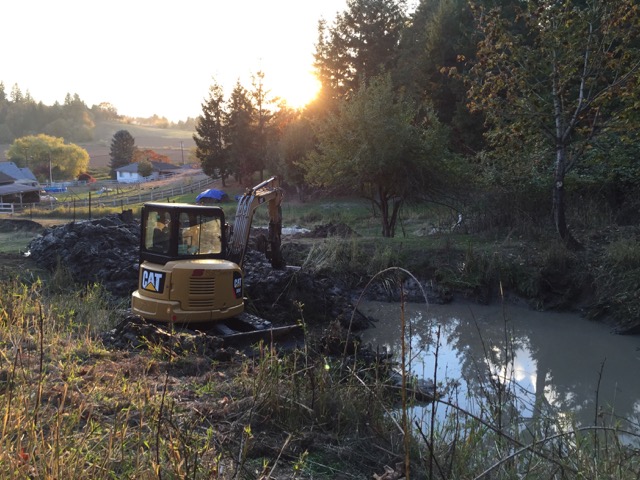
Another neighbor dug out our marshy pond and the marsh muck formed several more berms. Digging out the overflow trench for the pond gave us another two.
One neighbor cleared out an overgrown path across the front of his property. He obligingly dragged his brush into our lower pasture, giving us the material for three more massive berms.
Gardeners cleaned out another neighbor’s yard and dumped all of the cuttings onto yet another berm. Another load of firewood laid the base for two more.
And we have barely begun our fall and winter pruning and trimming.
Our hillside is covered with berms. The chickens stroll through the maze, murmuring to each other, scratching the softening surface, aerating the soil. The llamas add their rich manure pellets that we sprinkle along the berms. The rains have started, the organic matter is starting to break down, the nutrients are trickling down into our soil. Our hillside is drinking deep.
We made a simple commitment, and solutions came from every direction, each one completely unexpected and unplanned. It’s only been two months, and our hillside is wonderfully transformed. It will take some time for the berms to melt down to the point that they can support plants themselves, and in the meantime, they slowly, generously, continuously feed our hillside.
The simplicity of the concept of berms, the simple act of committing to build them, and the simple solutions that presented themselves, one after the other, after the other, leaves me with a deep sense of peace and joy. The llamas, the chickens, the rain, the sunshine, and the berms will work together, creating a healthy hillside that will flourish for decades. We will watch the transformation, breathing in the deep beauty of this simple life we live.

Tuesday, October 28, 2014

Global Connections

I’m a scientist by temperament and by training. For many years, I worked as a biologist in a pharmaceutical company. Our research department had a sister department located in Japan. Because of this partnership, our lab had a series of visiting scientists from Japan. They were always young people, with a spouse and perhaps with a fledgling family, trying to fit into this foreign place. Since science is internationally interwoven, we had visiting scientists from other countries as well: Australia, Brazil, England, France, Spain, Switzerland, Sweden. They would stay here for perhaps two years, and then return to their own labs in their own countries.

Halloween is a traditional American holiday. It can easily appear silly to people from other cultures. They just don’t quite get it. So every Halloween, my housemate and I would invite the visiting scientists and their families to our home to carve pumpkins. We’d also invite a couple of Americans and their children, to create a balance of experience and bafflement. We’d all sit on the floor throughout the house, newspapers spread in front of us, fresh pumpkins at hand with more on the lawn outside, and tea candles ready next to the front door. We’d start to carve our first pumpkin.

You know, if you’ve ever carved a pumpkin, that it can be a gooey mess. If you’re from another culture, like Japan’s, where food and body are kept very clean and very separate from each other, pumpkin carving could appear completely puzzling, intimidating even. But all of our guests politely started, regardless of inner turmoil, watching nearby friends for clues. The experienced carvers would offer witty advice wherever necessary, and generous encouragement to cautious skeptics.

Imagine the surprise and dismay of opening your first pumpkin and looking down into all that pale orange mess, the strings, the seeds, the oddity of it, the slippery randomness of it. Imagine reaching your hand in and feeling the slime and the endlessness of those inner curves. But looking around, others are doing the same thing, talking and laughing, so you bravely move forward, scooping out the seeds, scraping out the strings, cleaning out your hollow. Okay, now what?  Draw a face??  A scary face???

The first set of jack o’ lanterns are simple and a bit awkward. Two eyes, a mouth, sometimes with teeth, maybe a nose. As each person finishes his pumpkin, he stands up, carries it to the front door, inserts a tea candle, sets the pumpkin in the garden outside, and lights the candle.

Night is falling, and slowly the garden fills with jack o’ lanterns. The candles softly glow, brightly, then even more brightly against the darkening backdrop. The Japanese eyes fill with delight.  The French man grins and scurries off to get his next pumpkin. The Australian scrutinizes the others’ handiwork and tackles his next globe with blooming creativity. The carved faces become haunted, or lecherous, or jeering. Carved flames leap from mouth corners; carved eyes glower. The jack o’ lanterns are no longer consigned to the lawn; now they’re lurking behind rocks, gaping up from under a bush, cackling down from a tree branch.

The transformation is complete, for pumpkins and humans alike. We gather with hot apple cider and wander around the garden, delighted. My Finnish friend puts her arm around my shoulder and says delightedly, “Now I understand Halloween. Now I get it.”

So here I am on the spiritual path.  I have arrived at the party and understand portions of what I’m encouraged to do.  I look around at people I trust and admire, and pay attention to the example they set.  I’m learning that the way to learn is to do.  I’m delving into my pumpkins, each and every one of them, creating the most magnificent jack o’ lanterns that I can.  And I trust that by the time I’m standing in the garden, sipping hot apple cider, watching the glowing faces around me, I will understand why God is expending so much energy to create us, waiting for us to search for Him, and then helping us to find Him.

Tuesday, October 21, 2014

Seasons

It's mid-October and the world is changing. Greens are blending to golds on the trees outside my window. The sun is lower in the sky, sending softer light onto our hillside. The days are shorter, the nights longer. Rain falls regularly on our summer-parched pastures, soaking the llamas backs, and sending the chickens to hunker closely under their overarching tree. The season is changing.

I spend most of my days outside, working on this project or that, and I find that I'm more aware of the season's change than ever before. For one, it's more pronounced than in the Bay Area, so there's more difference to note. But more, I'm blending with my surroundings now, watching the sky and birds, the trees and wind. I'm learning about our hillside, the pond, the new orchard, our llamas and chickens.

The fruit trees are bringing life, an energy of their own to the pasture above our house. I'm taller than them still, but their aura is bigger, richer, softer. They've learned the sun's pattern, and have built their leaves to match, drinking in sunlight to fuel their hard work of growing up. Their roots have taken hold and explored their underground neighborhood. They've discovered water pockets and mineral caches, sending massive supplies of materials upward to the leaf factories breathing in and out, in and out. I spread wood chips and llama droppings in a lake at their feet, gifts to help them thrive.

The chickens murmur softly as they wander about their chores, checking this, pecking that. They scurry to meet me, as I open the gate, running, flying, calling out; I'm an exciting event in their day. I might bring treats or fresh water or mounds of grain. They follow along around me, remarking busily, ready to be a part of whatever I might have in mind.

The llamas watch intently and gather close in, sizing me up, looking for apples or pears. After a leisurely greeting, they turn to graze alongside while I dig or lop or rake. They clomp gracefully along, with an occasional cavort, gleefully snorting.

The pastures are turning green after the summer drought while the trees are turning golden in preparation for the cold; a changing of the guard, trading dormancy for robust vitality and vice versa, a biannual handoff amongst hillside companions.

I wade through this rich tapestry, watching the sky, the clouds, the sunset, and I say to myself, what a wonderful world.

Friday, August 29, 2014

Karma Ends

Dambara and I spent the morning chipping away at our brush pile. It's huge. It's taller than me, maybe 7 feet high, about 20 feet deep and, I don't know, 40 feet long? Last spring, we hired a young man to take out some hazelnut trees that stood in the path of our planned deer fence, and he got pulled into another job before he was able to chip the wood for us. So it's waited all these weeks, patiently drying out, growing larger and larger, as we added a hefty dead tree and many, many pruned branches.

It's hard to hire help out here in the country. People are either overwhelmed keeping on top of their own to-do lists, or in great demand, or feel it's not worth their time to drive out this far in order to do the work. So, we end up doing a lot of things ourselves that would be much better undertaken by people who knew what they were doing, who had the right tools, and who had the time, which we do not.

We finally surrendered to the inevitability of Plan B (Looks Like We're Going To Do It Ourselves) for tackling the brush pile, and bought a chipper and a small, electric chain saw that was light enough for me to wield. We gathered safety glasses and protective headphones, thick gloves and water bottles, and trod up the hill where the brush pile loomed.

We've whittled away at the pile, every morning, until the heat drives us indoors. The chipper, which looked so huge when it arrived, seemed dainty when initially stationed next to the brush pile. Now, it's regaining some of its heft, as the neighboring pile diminishes, bit by bit.

We're at the icky part, where it feels like we've been doing this forever, and there's still a LONG way to go. We can see our progress, not only by our ever more dominant chipper, but by the expanse of long, green grass uncovered each day, which is happily chomped down by the llamas each evening, giving us an ever widening wedge of flat hillside on which to lop, saw, and chip.

We've already changed out a dulled blade and a damaged drive belt, so we're getting to know our friendly chipper pretty well. We remain on good terms, us and the chipper, mutually respectful. We admire the chipper's strength and endurance; the chipper responds greedily to our hands with their opposable thumbs, repeatedly cramming branches down its feed tube. It's consuming an impressive amount of branches, and producing an impressive volume of wood chips, which we're spreading around our young orchard trees to nurture and encourage all those tentative root systems.

But, as I said, we're still in the icky middle, where we cannot yet see the end of the tunnel, much less the light that must be shining somewhere up ahead. And I'm reminded of some advice that a friend gave me years ago, when I was swimming in a vast sea of dismay over a seemingly endless challenge that was simply not improving or shifting: "Karma ends."

If we keep working at the task at hand, no matter how seemingly endless, we will come to its end. If we gather the right tools, be it meditation, living in community, or a lightweight chain saw; if we summon the right attitude, be it gratitude, power, or joy; if we persevere at a pace that we can sustain over the long term, in the company of an enthusiastic partner, like-minded souls, or even in seclusion; we'll consistently make progress. We can overcome a destructive habit or an immense brush pile, learning useful strategies along the way, and finally, finally, arrive at the point where we can easily handle the next pile of pruned branches, or, the next refrain of an old habit.

Because, karma ends.


Friday, August 22, 2014

Efficiency Isn't All It's Cracked Up To Be

My husband and I ordered a chipper, to aid us in managing our aging trees, as well as looking forward to our youthful orchard growing up and needing sculpting along the way. Also, our soil has a lot of clay, so the wood chips will be a welcome ingredient in our cycle of farm life.

Dambara is a gifted internet researcher, so he found the perfect chipper for us, affordable, powerful, and move-aroundable. The adventure began upon the arrival of our friendly delivery truck driver. We live out in the country, surrounded by peaceful hillsides, with a fairly narrow highway out front. Our friendly driver parked his 36-foot delivery truck on half of the highway, hiked up our somewhat steep gravel driveway, and kindly announced that he could leave the boxed chipper at the entrance of the driveway. His truck could not make the turn into the driveway, and since it was now at the end of his day, his next-to-empty truck would probably not make the climb up the driveway.

He was so friendly. Upon finding out that my husband was out of town for several more days, he gamely tackled the possibility of using his walk-alongside forklift to bring the heavy box up the driveway. We made it half-way up, then he set the box down at the edge, leaving enough room for cars to sneak by, in the interest of saving his friendly forklift from permanent meltdown.


I waved him on his way and called for help.

My friendly neighbor chugged his bright orange tractor, complete with front loader, along the narrow highway, up the gravel driveway, churning here and there, and was able to hoist the boxed chipper the rest of the way up the driveway, and oh joy of joy, up into the pasture where our enormous brush pile lurked.

I waved him on his way and turned to examine the boxed monster, which stood almost as tall as me, and much, much wider and heavier. Luckily, my variegated background includes paper art, so, Exacto knife in hand, I attacked the admirably stalwart packaging. Cardboard corners, and plastic wrapping, and mysterious parts were strewn around the hillside, but there it stood, in all it's black and orange glory, like an ungainly Halloween costume, ready to chew and chomp anything I might decide to feed it.

The packaging included a wrench for tightening bolts and very clear instructions on how to attach handles, feeding chutes, and trailer hitch. Luckily, I wasn't expected to build the engine. I can put together any Ikea product imagined, but I draw the line at metal objects that whirl around at a scrillion revs per second.

There were perhaps two dozen bolts that needed tightening, and most were only moderately accessible, necessitating a repositioning of the wrench at every half turn. As I sat next to my new workmate on the sunny slope of our upper pasture, working each nut slowly, steadily to a firm fit, I thought, "I should go get Dambara's socket wrench. That would be much more efficient." And then I realized that I had no intention of upgrading tools. I was looking out over our beautiful valley, hearing the birds, watching the chickens explore their new excavation, with the llamas migrating serenely past on their way to check the apple trees. . . . why would I want to hurry through this task? I was bonding with my chipper, getting familiar with her heft and strength, immersed in joy. The longer I could be here, doing this, the longer I could experience joy.


About 24 hours elapsed between the arrival of the chipper and the driver clumping up the driveway to strategize delivery schemes with me, to the coaxing of my neighbor's tractor past our carport and through the pasture gate, to me sitting in the sun putting the finishing twists to an array of well-designed bolts. Nothing had been hurried. Kindness and generosity flowed happily through every twist and turn. Joy burbled and spread and lingered.

My days are gentle and peaceful, filled with a joy that shepherds me along from task to task. Efficiency has taken its proper place, far down the list of priorities. It has taken me 60 years to get here, but for this moment was I born.

Tuesday, August 19, 2014

It's a girl! No. . . it's a boy. So is she.

We finally received the papers on 3 out of 4 of our llamas a couple of weeks ago. The previous owner had promised the papers to us, and had some trouble locating them, but then here they are! Hurray!

It was sort of a mishmash of papers, so it was an interesting read going through them and figuring out which papers belonged to which llama. We knew the birth name for one of them, but not the other three. Luckily, one paper for each llama included a description. . . "white with black tail" . . . "King Louie". . . "gelded male". . . . check! That's the one name we knew. He's now Ahimsa. Then there's "deep brown". . . . "female". . . . there's only one with that color fur, so check! That's Prani. . . . "White with grey body". . . that must be Santosha, so che. . . wait. . . "gelded male". That's weird. We have 3 girls and 1 boy. Ahimsa's the boy.

Great. We have papers on 2 of the llamas, and the other 2 are still a mystery. Plus there's this set of papers on an unknown gelded male. That's not so useful.

As the days went by, I kept thinking about the papers. White with grey body; gelded male. That really does describe Santosha. The color part, not the anatomy part. I wonder whose papers those are. . . .

You might think that it's easy to tell the gender of a llama. Not ours. They're wary of people, and keep their noses pointed straight at us; all the better to see you, my dear. And their fur is long and thick, reaching far lower than is easily convenient for peering at their nether regions. But, IF they do happen to have their backs to you, and IF they swish their tails at just the right moment, it is possible to glimpse what might be there.

Dambara saw it first. "Definitely a boy." Then we paid attention to their peeing habits. Prani, the confirmed girl, sent it behind her. Ahimsa, the confirmed boy, sent it forward, to land under his bellybutton. Santosha, caught in the act, peed forward, giving another convincing gender clue. She's a boy. A gelded boy.

Then all eyes turned toward Satya. No papers, no descriptions, no nothing. The previous owner had told us that we were buying 1 boy and 3 girls. Since he was wrong about one of the girls, might he be wrong about another one, too?

She's so timid. She and Prani hang out together all the time. The girls hang out together and the boys hang out together. It all makes sense when you assume that she's a girl. Then again, a glimpse. Another glimpse. Sure looks like a boy. Or is that a mammary gland?

It's surprisingly hard to find out boy/girl llama clues on the internet. You have to be careful of your search words, or you can end up on some very odd sites. The FBI probably monitors those sites. At least I hope they do.

Pee watch was surprisingly hit and miss. We're not out there all the time, and they pee at any time of the day or night. Who knows when? Plus, it makes a lot more sense if Satya is a girl. She acts like a girl.

A video went around Facebook a couple of weeks ago, asking young women to  pantomime throwing like a girl. It's a very moving, insightful video about stereotyping and how we diminish people when we indulge in those thoughts and sneers. My stubborn insistence that Satya acts like a girl was simply stereotyping her into a body of false information, demeaning for all species.

So, moving past my stubbornness, we're now accepting the fact that Satya is a boy. He's timid, and he panics easily. He likes hanging out with Prani. Maybe Prani is his mom. Maybe her smallness reassures him. Maybe they like the same music or share a delightful enjoyment of puns. Whatever the case, we have, not 3 girls and 1 boy, but 3 boys and 1 girl. And they're perfect, every single one of them. Our friends, the llama troupe.

Thursday, March 6, 2014

Food tastes funny today

I awoke this morning feeling a bit odd. Not a scratchy throat; not nausea; something more subtle. Something was on its way, and I wanted to nip it in the bud.

I dosed myself with grapefruit seed extract. Now GSE is tricky, because it's a viscous liquid that has The Worst Taste I have ever experienced. But I've learned that if I dilute it into a protein drink, the viscosity of both liquids blend nicely, and the flavor of the protein drink masks the bitterness of the GSE. The other trick about GSE is that it can really upset your stomach. So as soon as I dosed myself, I felt the first niggly nausea starting to coalesce. I grabbed something out of the fridge, protein rich, and ate a few bites and got ahead of the nausea. Whew. You'd think I'd remember from GSE regimen to GSE regimen that I need something in my stomach first.

ANYway. . . . 'round about 11:00 I started to feel a bit odd again. Time for more GSE. FIRST, I was going to eat lunch, and a SALT sandwich sounded really good. So I got out the stripples, avocado, lettuce, but not the tomato, and made a yummy SALT-minus-the-T sandwich. It wasn't very good. It looked great, it smelled great, I usually LOVE them, but my taste is off, because of whatever this thing is that's being subdued by the GSE in my bloodstream. Currently the GSE is winning the battle, and here I am, happily typing away.

I expect some day to have complete control over that secret yogic power that allows us to heal ourselves. For now, I need a sidekick, and oftentimes my sidekick is GSE. Colds and flu, all those insidious little pranksters that can lay us low, GSE helps me triumph every time. It takes 2 or 3 days for the prankster to go away completely, but during those days, I keep up my usual routine, pausing every 3 or 4 hours, when I start to feel a bit icky, to take another dose of GSE, and I'm up and running again. For me, it works. When I use it.

Now, I've told LOTS of other people about this method, and I know of only 1 other person that has the same empowering results that I experience, and she's the person that told ME about GSE. That gives me pause. Are other people not doing it right? Does GSE help only a small group of people? Or is it perhaps that I believe it's going to help, and so it does help?

I'm all for the placebo effect. Give me the placebo and let my optimistic attitude carry the day. That's fine with me. I get well, plus I don't have to deal with side effects. But what is the placebo effect? Does it depend on right attitude?

We're moving into a higher age, where we're becoming more aware of subtle energies. Body work, energy work, hands-on healers, all kinds of techniques are being discovered, taught, and learned by more and more people. Subtle health techniques are healing more and more people. The subtly of healing energy is exquisite and captivating. It's a wondrous time to be living on this planet, watching this subtle wisdom emerge from the shadows.

I drip essential oils onto my forearms every morning. They enhance my metabolism and soothe my arthritis. When I don't use them for 3 or 4 days, my energy dips and my old running injury grinds away at the tenderized edges of my hip, and I start limping. When I go back to the oils, my energy returns and my hip sighs happily into quiet warmth. The oils work. When I use them.

If we meditate every day; if we energize and listen for aum, if we pray, or chant, whatever combination of techniques we've pieced together that connect us to the inner peace of the divine, we move through our days more centered, more intuitive, more ready for whatever our day brings to us.

These are subtle energies, but the techniques to connect with them work. The techniques work, if you use them. Our only job is to remember to use them.